By Gouranga Nandy
A TRAGEDY is quietly unfolding in Bangladesh’s south-west. The Water Development Board has for decades treated the rivers like clogged pipes that need ‘cleaning’ through expensive structural engineering model, including mechanical dredging. Yet, as any resident near the Kobadak or Hari rivers will say, the silt returns almost as fast as the machines can remove it.
It is known to all that the south-west region is a vast deltaic plain criss-crossed by a network of tidal rivers such as the Pussur, the Sibsa and the Kobadak. The rivers are influenced by the daily ebb and flow of the Bay of Bengal tides. The rivers overflow during high tide, depositing nutrient-rich silt onto the floodplains. In the 1960s, however, the ‘green revolution’ led to the construction of polders, which are a kind of water management devices with embankments, sluice gates, drainage channels all bundled together. While this initially boosted agriculture, it stopped the natural siltation process. The silt began settling on riverbeds rather than on land, choking the rivers and leading to permanent water stagnation in human settlements.
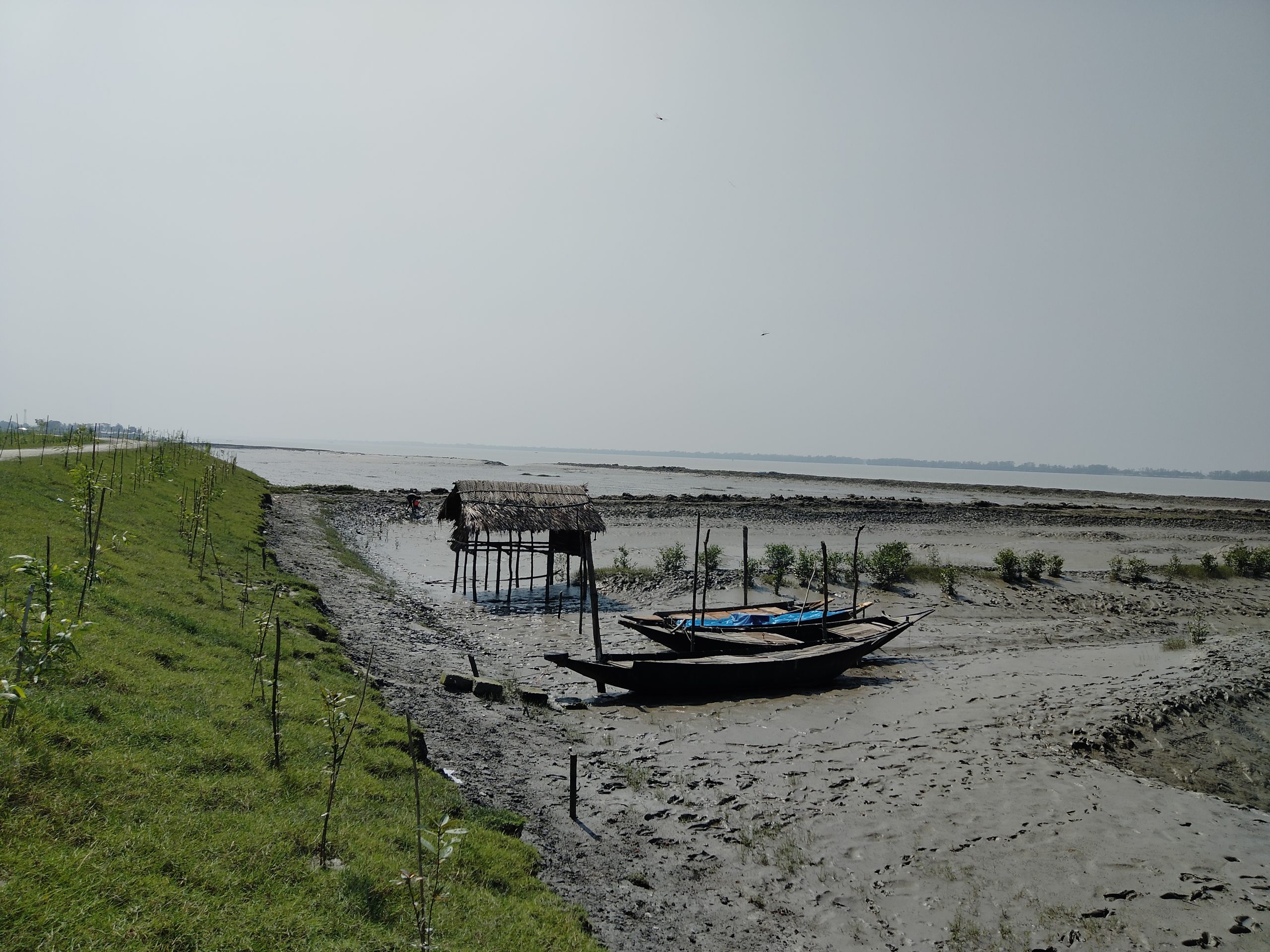
The result that we see now is Bhabadaha, where people have been living with water for almost three decades. By the early 2000s, the River Kobadak effectively ‘dead’ in many stretches, with massive siltation deposited in the river bed. Since the river could no longer deposit silt on the floodplains, the riverbed rose higher than the surrounding land. This led to a permanent water stagnation across 20,000 hectares of land, affecting over a million of people in Jashore and Satkhira. Schools, houses and farmlands remain under water for 8–10 months a year. The coastal embankment project of the 1960s broke the natural ‘river-floodplain’ connection. When rivers are embanked, silt cannot reach the floodplains. It settles, instead, in the riverbeds. The Kobadak and the Hari lose up to 10–12 metres of depth because of this ‘internal siltation.’
The Water Development Board goes for a structural solution, with embankment repairs, sluice gate construction, or reconstruction and dredging, to remove the stagnant water. But all prove ineffective. People continue to suffer. People are, in fact, trapped in a ‘silt-dredging cycle’ in which public funds are diverted into temporary, high-contract engineering fixes while the land continues to sink and the people continue to drown in permanently stagnant water.
However, the solution is not hidden in a laboratory. The science of ‘working with the tide’ exists. It is the tidal river management. It is an eco-friendly adoption of measures that uses the natural energy of the tides to do what machines cannot. By strategically breaching embankments, we allow sediment-heavy water to enter low-lying basins, which are bils. The silt settles, raising the land by metres, while the receding tide naturally ‘scours’ and deepens the riverbed.
Tidal river management is a unique, community-driven water management technique that is an appropriate solution to water stagnation in the south-west coastal region. It is essentially a strategy of ‘working with nature’ rather than fighting it with permanent embankments. However, if tidal river management is considered, social-ecological system must be considered, too. Because tidal river management is an ecological success. It is a temporary social disaster. Because farmers lose 85 per cent of their crop production if a bil remains for three three to five years. As a result, it is essential to provide the affected people with compensation. The compensation failure is identified as the primary reason for community resistance in places such as Bil Kapalia and Bil Khukshia. On the other hand, wealthy shrimp enclosure owners often oppose tidal river management because it disrupts their high-profit salt water aquaculture although it benefits the long-term health of the river.
Tidal river management is a process of shifting the sedimentation. By breaching embankments, the high tide carries sediment into a bil, or basin. As the water loses velocity, silt settles. The resulting low-tide outflow is powerful enough to wash out the riverbed, restoring its depth. Study finds that in Bil Khukshia, tidal river management raised the land by 1 to 1.5 metres in only three years although the silt tends to pile up near the ‘link canal,’ the entry point, leaving the far ends of the bil low. Scientists now recommend using multiple link canals or internal compartmentalisation to ensure that the entire bil is raised equally.
The most significant tidal river management project on the Kobadak was centred on Bil Pakhimara at Tala in Satkhira. The embankment was breached to allow tidal water to enter the 700-hectare Bil Pakhimara. During high tide, the river pushed sediment into the bil. During low tide, the receding water ‘scoured,’ cleaned out, the Kobadak riverbed, naturally deepening it without expensive mechanical dredging. Typically, a tidal river management cycle in a bil like Pakhimara lasts for three to five before the land is raised enough to be reclaimed for farming.
As a result, river navigability is raised. The Kobadak, which had become a narrow, stagnant canal, regained its depth and flow. In bil areas, the ground level rose by 1.5 to 2 metres, ‘creating’ new, fertile land out of former swamps. Once the water drained, farmers reported bumper harvests due to fresh nutrient-rich silt deposits.
Despite the success, the implementation of tidal river management on the Kobadak has been plagued by delays from the Water Development Board. Tidal river management requires farmers to leave their land fallow while it silts up. The board was notorious for delaying ‘compensation’ payment to the farmers, causing anger and protests. The board repeatedly proposed mechanical dredging, which costs billions of takas and only lasts 1–2 seasons, over tidal river management. Local people often view this as a way for the board to favour contractors over a natural, permanent solution. In Bil Kapalia, which is on another part of the Kobadak system, the Water Development Board tried to implement tidal river management, without proper community consultation, leading to violent clashes between the authorities and local people.
The Water Development Board, in fact, prefers dredging for its structural bias. Because the board is built on a ‘command and control’ engineering philosophy. Tidal river management is ‘messy’ because it involves community negotiation, land rights and natural timelines. The board personnel are not able to handle people’s sentiments properly and the social-ecological system. The mechanical dredging is a temporary fix. Without tidal river management, a dredged channel in the south-west is often silted back in one or two seasons, creating a lucrative ‘cycle of re-dredging’ for contractors that drains the national exchequer without solving the root cause.
Tidal river management compared with dredging in the Kobadak shows that tidal river management lasts for 10–15 years, but dredging lasts for 1–2 years. Tidal river management is low-cost whereas dredging is high-cost, with its fuel and machinery. Tidal river management raises land height but dredging does not have any impact on land height. Social management is necessary in tidal river management, but dredging produces environmental waste.
There should be a shift in water management policy. The authorities should veer away from dredging and should, rather, spend a portion of the dredging money on pre-breach compensation funds for coastal farmers. It is important that people Satkhira and Jashore should be treated not as people affected by projects but as partners in delta management to establish ecological justice. The national adaptation plan must mandate tidal river management over dredging in tidal zones.
Courtsey: NEWAGE, 19 April, 2026